

Macroeconomic challenges, including high interest rates in the U.S. and the devaluation of the real against the dollar, have not had a substantial impact on the number of Brazilians entering the U.S. real estate market.
According to data from the National Association of Realtors, Brazilians ranked fifth among foreign buyers of U.S. real estate in 2022, both in terms of the number of properties purchased and the total financial volume, accounting for 3% of the market. Florida was the most popular destination (55%), followed by New Jersey, Wisconsin, Louisiana, Georgia, North Carolina, and New York.
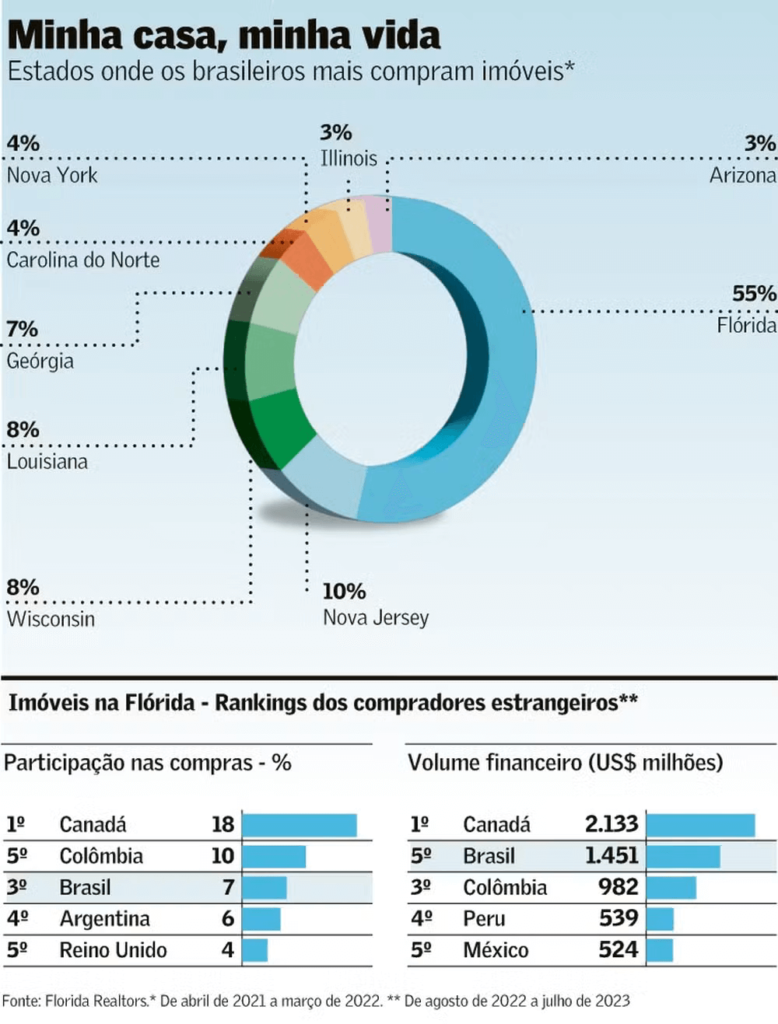
Another survey, conducted by Florida Realtors, reveals that Brazilians ranked third in terms of the number of real estate buyers in the state in 2023. In terms of total amount spent, they ranked second, with a total of $1.451 billion, up from the $486 million recorded in 2022.
According to Ricardo Molina, a real estate broker at Talent Realty and CEO of Vollare Immigration, Brazil’s politically polarized landscape and economic uncertainties have driven demand for asset protection and income in U.S. dollars. “The U.S. real estate market remains attractive to those seeking a strong economy, a strong currency, and legal certainty.”
According to Andrea Pointon, CEO and broker at Pointon Realty, high interest rates have had a greater impact on American consumers than on foreign buyers. When interest rates began to rise, there was a lull, but sales gradually picked up again. “This year, sales are holding up well, even in an election year, which has been a pleasant surprise for me,” she says.
According to André Duek, head of the Duek Lara Group, the macroeconomic landscape has not dampened the interest of buyers with higher purchasing power. “Looking at the upper-middle class and above, I’ve seen even higher transaction volumes than before,” says the broker.
In addition to nonresident investors focused on monthly rental income, there are an increasing number of Brazilian immigrants purchasing real estate, with significant changes in their profiles. In recent years, there has been a surge in the number of Brazilian professionals with academic degrees moving to the country.
According to Daniel Ickowicz, CEO and sales director at Elite International Realty, it is common for Brazilians to purchase smaller properties as a “test drive.” “Later, when they decide to actually move in, they end up keeping the smaller properties as a source of extra income and buy larger ones to live in,” he says.
According to real estate agents, the net return on rental properties in the U.S. ranges from 5% to 7% per year, plus property appreciation. Generally speaking, rental income is subject to income tax based on a progressive tax scale. And for rentals listed on platforms such as Airbnb, sales tax—similar to the ICMS—is also due.
Another way to invest in real estate in the United States is through REITs (Real Estate Investment Trusts) traded on stock exchanges, which operate similarly to real estate funds in Brazil.
REITs are companies that invest at least 75% of their assets in real estate and, by regulation, are required to distribute 90% of their taxable income in the form of dividends—which typically occurs monthly or quarterly.
This is one way to gain exposure to a new geographic market and different opportunities. “The United States has sectors that don’t even exist in Brazil, such as data centers and cell towers. In addition, the residential REIT sector is strong,” explains Paula Zogbi, head of Content at Nomad. “We’ve seen growing interest among Brazilians in REITs as alternatives for diversification and dollar-denominated income; in fact, some assets are already significant in terms of volume under custody,” says William Castro Alves, chief strategist at Avenue. He notes that, in general, REITs have suffered in the short term due to rising interest rates. “On average, REITs are 30% below their all-time highs, which leads us to believe that these companies have the potential to return to the levels they were at once interest rates ease,” says Castro. Today, according to him, the average dividend yield for REITs stands at 4%.
“We’ve seen growing interest among Brazilians in REITs as alternatives for diversification and dollar-denominated income; in fact, some assets are already significant in terms of volume under custody,” says William Castro Alves, chief strategist at Avenue. He notes that, overall, REITs have suffered in the short term due to rising interest rates. “On average, REITs are 30% below their all-time highs, which leads us to believe these companies have the potential to return to where they were once interest rates ease,” says Castro. Today, he notes, the average dividend yield for REITs stands at 4%.
See the original article at this link:
https://valor.globo.com/publicacoes/especiais/brasil-eua/noticia/2024/05/22/compra-de-imoveis-na-florida-e-opcao-para-proteger-patrimonio.ghtml?giftId=f81ad59bf8f6de7&utm_source=Email&utm_medium=Social&utm_campaign=sharearticle